Overview
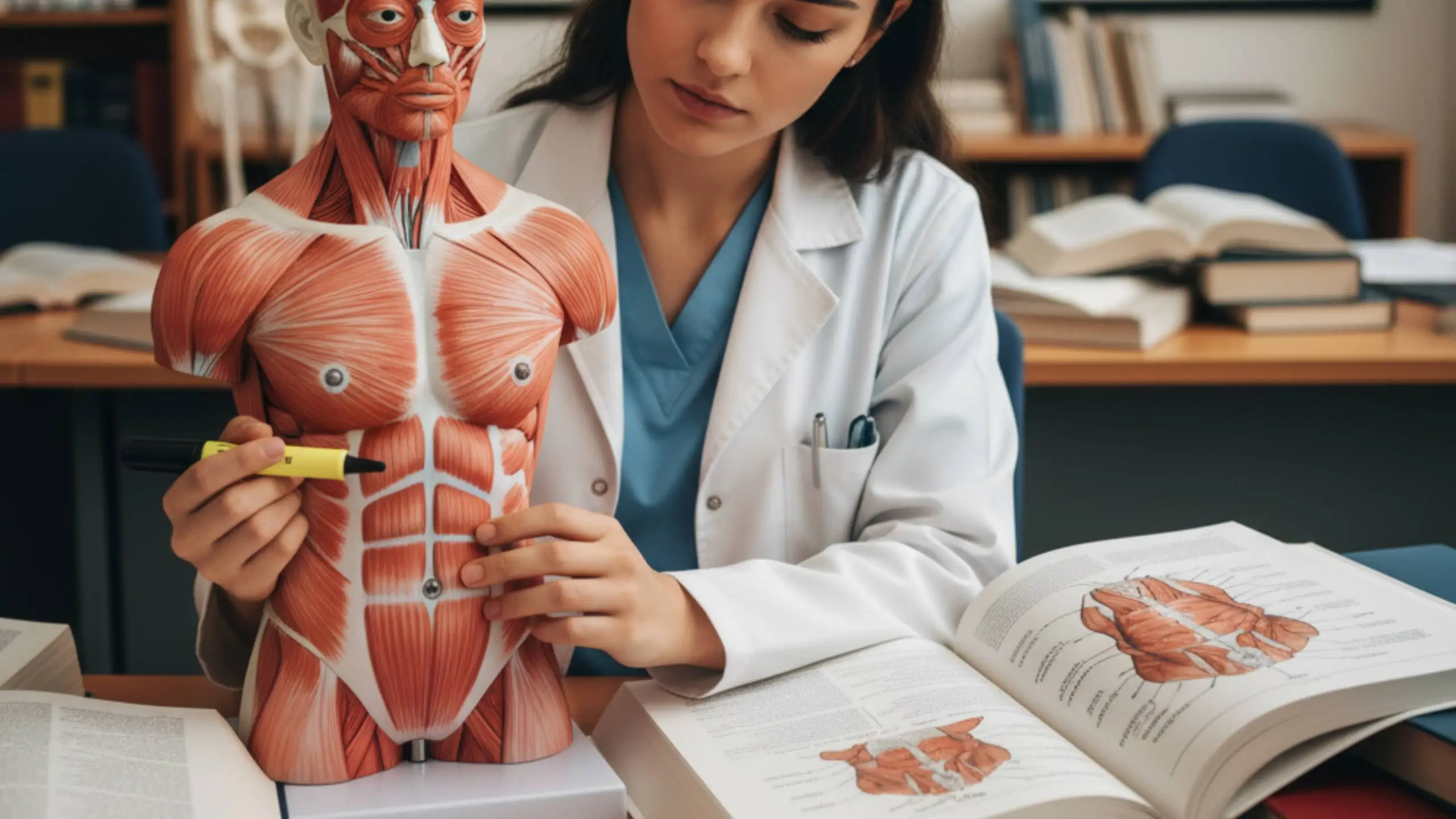
The abdominal wall consists of layered muscles that protect abdominal organs, maintain posture, assist respiration, and generate movements such as trunk flexion, lateral bending, and rotation. This summary table provides a clear, structured review of all major abdominal muscles with their origins, insertions, actions, and nerve supply.
For sectional anatomy, see layers of the anterior abdominal wall. For groin-related anatomy, refer to inguinal ligament and inguinal canal.
Flat Muscles of the Abdominal Wall
These muscles form three layers on each side: external oblique, internal oblique, and transversus abdominis.
Flat Muscles
| Muscle | Origin | Insertion | Nerve Supply | Main Action |
|---|---|---|---|---|
| External Oblique | Lower eight ribs (5–12) | Linea alba; pubic tubercle; anterior half of iliac crest | T7–T12 thoracoabdominal nerves | Flexes and rotates trunk; compresses abdominal contents |
| Internal Oblique | Thoracolumbar fascia; iliac crest; inguinal ligament | Inferior ribs (10–12); linea alba; pubis | T7–T12 thoracoabdominal nerves; L1 (iliohypogastric and ilioinguinal) | Flexes trunk; ipsilateral rotation; compresses abdominal contents |
| Transversus Abdominis | Thoracolumbar fascia; iliac crest; inguinal ligament; lower six costal cartilages | Linea alba; pubic crest | T7–T12 thoracoabdominal nerves; L1 | Compresses and supports abdominal viscera; important for core stability |
Vertical Muscles of the Abdominal Wall
The two main vertical muscles are located near the midline and encased in the rectus sheath.
Vertical Muscles
| Muscle | Origin | Insertion | Nerve Supply | Main Action |
|---|---|---|---|---|
| Rectus Abdominis | Pubic symphysis; pubic crest | Xiphoid process; costal cartilages (5–7) | T7–T12 thoracoabdominal nerves | Flexes trunk; stabilises pelvis; compresses abdominal contents |
| Pyramidalis | Pubic crest | Linea alba (lower part) | Subcostal nerve (T12) | Tenses linea alba |
Posterior Abdominal Wall Muscles
These deep muscles support posture, respiration, and trunk stability. They also relate closely to lumbar plexus anatomy.
Posterior Abdominal Wall
| Muscle | Origin | Insertion | Nerve Supply | Main Action |
|---|---|---|---|---|
| Psoas Major | T12–L5 vertebral bodies and transverse processes | Lesser trochanter of femur | Anterior rami of L1–L3 | Hip flexion; stabilises lumbar spine |
| Iliacus | Iliac crest and fossa | Lesser trochanter (via iliopsoas tendon) | Femoral nerve (L2–L3) | Hip flexion |
| Quadratus Lumborum | Iliac crest; iliolumbar ligament | 12th rib; transverse processes of L1–L4 | T12; L1–L4 anterior rami | Lateral flexion of vertebral column; stabilises 12th rib during respiration |
Diaphragm (for comparative context)
The diaphragm is the primary muscle of respiration and forms the superior boundary of the abdominal cavity.
| Part | Origin | Insertion | Nerve Supply | Main Action |
|---|---|---|---|---|
| Sternal Part | Posterior xiphoid | Central tendon | Phrenic nerve (C3–C5) | Inspiration |
| Costal Part | Lower six ribs and costal cartilages | Central tendon | Phrenic nerve | Inspiration |
| Crural Part | Bodies of L1–L3; arcuate ligaments | Central tendon | Phrenic nerve | Inspiration; oesophageal sphincter function |
Clinical Anatomy and Exam Strategy
The abdominal wall muscles are key to understanding inguinal hernias, abdominal incisions, core stability, and breathing mechanics. For exams, memorise fibre directions (external: hands-in-pocket; internal: opposite; transversus: horizontal) and nerve supply patterns including L1 involvement for the internal oblique and transversus abdominis. Integrate this table with anatomy of the rectus sheath (rectus sheath) and posterior abdominal wall (posterior abdominal wall) for rapid revision.